Measurements vs. Gates
Measuring a single qubit shown diagramatically as
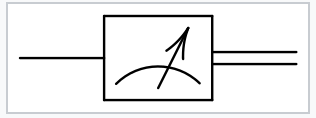
involves measuring the observable \(Z\)
So you might think - esp. based on diagrams like below:
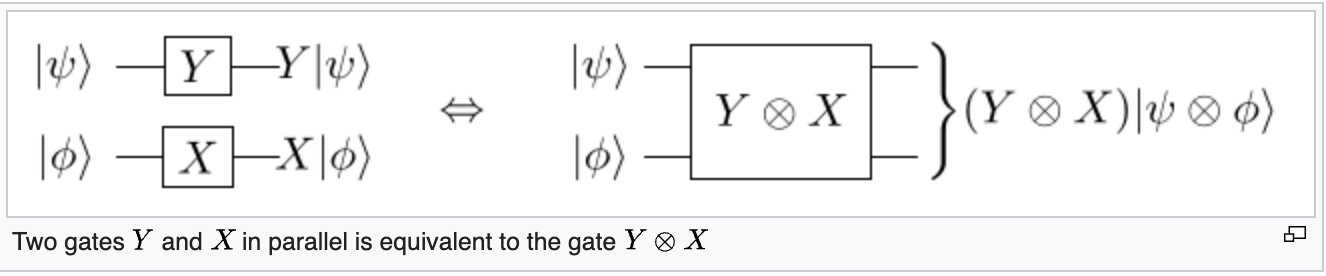
that measuring a two qubit system:
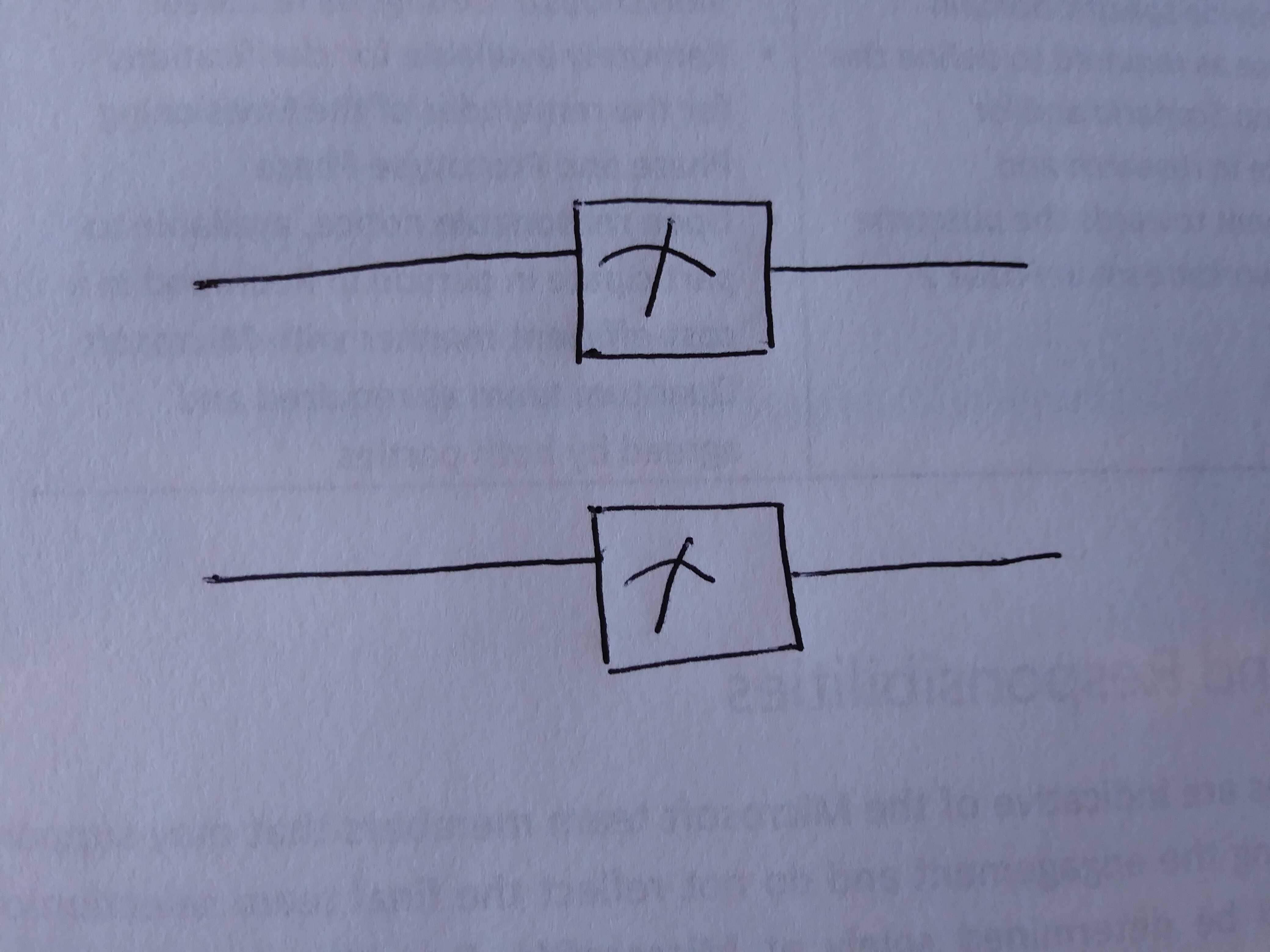
involves measuring the observable \(Z \otimes Z\). Let’s look at the matrix \(Z \otimes Z\):
⎡1  0   0   0⎤
⎢            ⎥
⎢0  -1  0   0⎥
⎢            ⎥
⎢0  0   -1  0⎥
⎢            ⎥
⎣0  0   0   1⎦
Verify, there are only two eigenvalues of this matrix \(+1\) and \(-1\).
So if you measure this observable you are only going to get 2 possible values or answers.
But a two qubit system can be in one of \(4\) states when its measured (00, 01, 10 or 11).
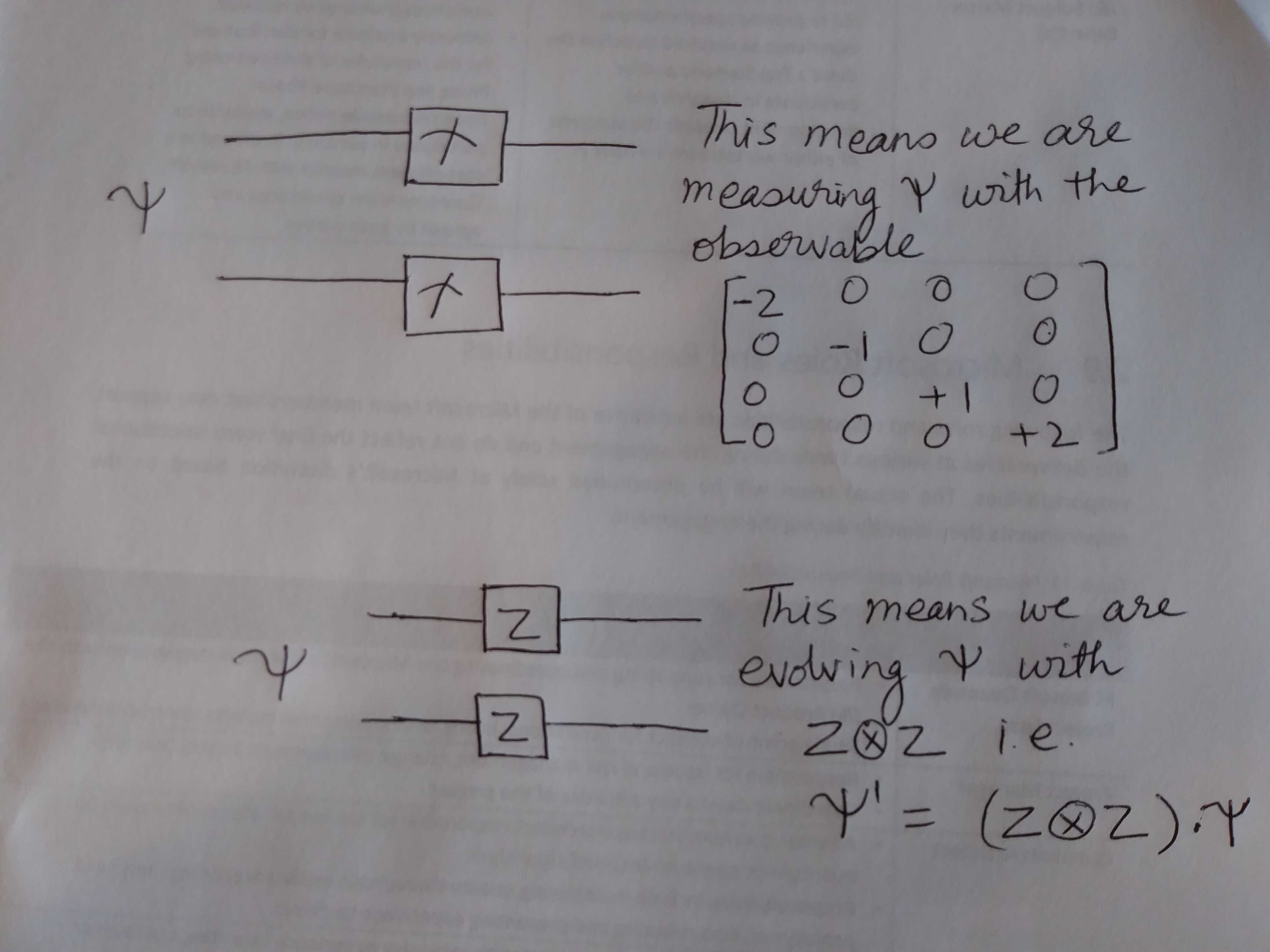
So what gives? Well the answer is that \(Z \otimes Z\) is not the observable corresponding to measurement of a two qubit system!
The correct observable (assuming measurement in the “computational basis”) is given by a \(4 \times 4\) diagonal matrix with distinct (i.e., no repeated) and non-zero real numbers on the diagonal. E.g., one such matrix is:
⎡-2  0   0  0⎤
⎢            ⎥
⎢0   -1  0  0⎥
⎢            ⎥
⎢0   0   1  0⎥
⎢            ⎥
⎣0   0   0  2⎦
It has 4 eigenvalues \({-2,-1,+1,+2}\) corresponding to the 4 states the system can be in when its measured.
We can summarize the learning in following figure:
In Quantum Computing, there is a big difference between gates and measurements. Gates are characterized by unitary matrices \(UU^\dagger=I\) and represent the time evolution of a quantum system. Measurements are characterized by Hermitian matrices \(M=M^\dagger\) and collapse the wavefunction to one of the eigenvectors (also known as eigenstates) of the observable (also called as operator). The rule for doing time evolution (Schrodinger’s equation; it becomes a simple gate or matrix in Quantum Computing; read Nielsen and Chuang p. 83 to see how the equation becomes a gate) is different from the rule for doing measurement (Born’s rule) and that is what all the hungama (drama for English readers) is about. This is what Lee Smolin is referring to in his talk:
(28:23) We have two laws… and that’s the whole problem!
Nobody said it better.
At 32:46 he says: "If we weren’t around, only Rule 1 would apply". That is what Einstein had in mind when he said:
Tell me, do you really think the moon is not there when you don’t look at it?
Anyway, let’s come back and consider a follow up question: \(Z \otimes Z\) is a Hermitian matrix as you can verify (\(M=M^\dagger\)). So it corresponds to an observable, but what? Answer: it corresponds to measuring value of first qubit (\(+1\) or \(-1\)) \(\times\) value of second qubit. That is the measurement you will get if you measure with \(Z \otimes Z\). For a system of \(n\) qubits measuring \(Z^{\otimes n}\) would give \(\Pi_i b_i\) where \(b_i\) is value of the \(i\)-th qubit (\(+1\) or \(-1\)).